Sunday, September 29, 2013

New Radioactive Cesium Absorbents

New Radioactive Cesium Absorbents 


Since the occurrence of the Fukushima Daiichi nuclear accident, Japanese scientists have been fighting the radiation disaster in their own ways.

One of results of their efforts is new material to absorb radioactive cesium more efficiently than conventional absorbent material such as zeolite and Prussian blue.

The National Institute for Materials Science of Japan developed new material made of silica which has an uncountable number of small dents and holes on its surface.  These pores have each the diameter of several nano-meters (several billionths of 1 meter ).  It can take only cesium.  Its performance of absorbing radioactive cesium elements is 100 times stronger than a conventional method such as zeolite.

The National Institute of Advanced Industrial Science and Technology (AIST) of Japan also proposed a new method of producing absorbent material for radioactive cesium.  They turn Prussian blue (PB),  conventional decontamination material, into the form of nano-particles.  By making PB transformed into the very small-size particles, they have increased performance of PB to absorb radioactive cesium.  


The effect of AIST's absorbent is demonstrated in the above figure.  The vertical axis is for the absorption rate; the horizontal axis for the liquid-solid ratio (concentration).  Red and blue lines are for nano particles; green for PB sold in the market; and black for zeolite. 


Other team of scientists have also developed a new type of absorbent material for radioactive cesium.  Scientists of Shinsyu University and Hokkaido University of Japan have invented a new method of taking away radioactive cesium using carbon-nano tube (CNT) material.  This material can absorb cesium 100 times more than Prussian blue (PB).  Specifically, they combine CNT and PB to put them into foamable resin.  When they pour radioactively contaminated water to this resin, it could remove 97% of radioactive cesium.

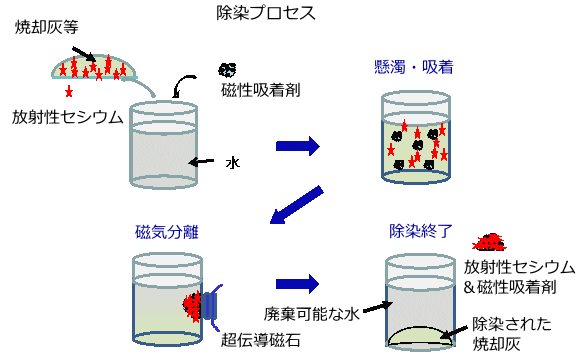
Mitsubishi Paper Mills has also completed development of magnetic absorbent of cesium called CS-Catch.  It is comprised of inorganic adsorbent and magnetic powder.  As inorganic absorbent, they adopt ferric ferrocyanide and zeolite.  Specifically, this product is put in water with burned ash of radioactively contaminated woods, weeds, concrete, and other substance. Then radioactive cesium melted into water can be collected by the magnetic absorbent.


There some other scientists and businesses in Japan which are engaged in development of new types of absorbent for radioactive elements which are discharged in a radioactive or nuclear accident. 

Some of these products are now being field-tested in the Fukushima Daiichi Plant.  Though the market of these types of material is limited, countries operating nuclear power plants should obtain them as measures to prepare emergency.


APPENDIX: How Prussian Blue Works in Absorbing Cesium

http://gtrgnriaist.blogspot.jp/2013/07/pb.html


###


Anti-Nuclear Group Demonstration Tent, Tokyo


Friday, September 27, 2013

Hiroshima Atomic Bomb Pictures

Hiroshima Atomic Bomb Pictures 


Yoshiro Fukui (1912-1974) experienced the atomic bomb attack by the US air force on Hiroshima in August 1945.

At the time he was in an army barrack which collapsed  under a huge blast of the nuclear bomb, though he was rescued from debris.  One hour after the big blast, that was around 9 a.m., Fukui decided to depict the scene of bombed streets of Hiroshima City just with sheets of paper and pencils.

http://www.academia.edu/3741687/Painters_Who_Did_and_Did_Not_Witness_the_Atomic_Bomb_The_Witnessing_and_Representation_of_the_Atomic_Bomb_

This picture was titled "No Title."  There portrayed was an urban district of Hiroshima City burning with black smokes in addition to some people lying on the ground.  Anyway it is the picture depicted in Hiroshima the soonest after blasting of the atomic bomb.

He also drew another picture at night of the day.  Fukui met a girls' high school student who was sitting on the ground facing flames of a burning town.  There was nobody else in the corner of the City; it was like some queer scene of a movie.  Fukui shouted at the girl, "Run, run away!"  But she continued sitting there facing flames caused by the atomic bomb dropped in the morning.

http://www.academia.edu/3741687/Painters_Who_Did_and_Did_Not_Witness_the_Atomic_Bomb_The_Witnessing_and_Representation_of_the_Atomic_Bomb_

"No Title," the focus on a girls' high school student facing flames all alone.

On the other hand, a very successful painter of Japan did not depict Hiroshima for 33 years after he experienced the atomic bomb attack.  Ikuo Hirayama (1930-2009) was conscripted at the time in an arms factory in Hiroshima.  In a lumber yard of the factory he was exposed to the blast of the atomic bomb.

But after the war, for many years he did not pick up Hiroshima as a theme of his art.  Nonetheless, when he visited Hiroshima on August 6 (the day when Hiroshima was attacked in 1945) in 1978, he decided to directly depict Hiroshima but not for keeping memory of atrocity of the war but for expressing rebirth and progress of Hiroshima.

http://blogs.yahoo.co.jp/iro_tory2/59709200.html
 "Picture of Hiroshima Living and Changing" by  Ikuo Hirayama, 1978 (The God of Fire or Acala was painted in the upper left space.)

Some artists who did not directly experience the Hiroshima atomic-bomb attack in person also painted the tragedy of Hiroshima.

Japanese painter Masao Tsuruoka (1907-1979) presented his image of Hiroshima in 1953 as below.

http://www.gallerysugie.com/mtdocs/artlog/archives/000183.html
"Vaporization of Human Beings" by Masao Tsuruoka, 1953

Tsuruoka was enlisted during WWII.  But soldier Tsuruoka got seriously ill in the Chinese front to be sent back to Japan.  He could barely escape the death.  Though he could survive the war, most of his picture works were lost due to the Great Tokyo Air Raids by the US Air Force in 1945.

Kikuji Yamashita (1919-1986) also experienced WWII as a soldier.  After the war he joined the Japanese Communist Party.  He left pictures today regraded as witness pictures of the Japanese history after WWII.  The following picture is thought to demonstrate the Japanese society after the Hiroshima attack and the defeat of the Empire of Japan.

http://www.academia.edu/3741687/Painters_Who_Did_and_Did_Not_Witness_the_Atomic_Bomb_The_Witnessing_and_Representation_of_the_Atomic_Bomb_
"O-TO O-Tem" by Kikuji Yamashita, 1951


Salvador DalĂ­ (1904-1989) of Spain also painted some pictures in response to the coming of the Atomic Era or the nuclear age.


Finally you can refer to Hiroshima atomic bomb pictures painted by ordinary Hiroshima citizens who survived the first nuclear bomb attack in the human history in the following sites:

http://a-bombdb.pcf.city.hiroshima.jp/pdbj/search_rule.do?class_name=pict

http://www.pcf.city.hiroshima.jp/virtual/VirtualMuseum_j/visit/art/art00.html


###


Mt. Fuji, Japan


Thursday, September 26, 2013

Survivor of 1923 Great Kanto Earthquake

Survivor of 1923 Great Kanto Earthquake 

On Sept 1, 1923, a magnitude-7.9 earthquake occurred almost at noon, killing 105,000 people around Sagami Bay and Tokyo Bay.

A very old woman, today 109 years old, remembers how she acted on the tragic day.

Tei Hidaka was a female clerk of a foreign firm situated near China Town of Yokohama City.  The 19-year-old female worker heard a roaring sound and then felt a very violent tremor.  She fell on the floor but managed to stand up with a great effort but in the next moment she fell again, which she repeated several times. Then somebody shouted, "Fire! Run away!"

After experiencing seven minutes of violent quakes, she fled to the Yokohama public park walking over a heap of rubble.  There were tens of thousands evacuees in the park.  The place was so crowded.  And big fires surrounded the park.  People were trapped there without a way out.   Hidaka extinguished small fires induced by sparks flying into the Park from burning buildings all through the day and even at night.  She also took care of the injured and the wounded in the horrible night.  The park was illuminated so ghostly by fires.

Then a long night was over.   She saw many dead bodies on the ground and streets.  Then she met some foreigners who were walking to Motomachi Town.  They kindly gave her some medicines and bandages.  With these medical aids, she began to take care of disaster victims on the street, forgetting about herself.

Later her individual relief activities became widely known, so that a newspaper reported on her with a title of "Angel Coming to Afflicted Streets."   Even the office of Kanagawa Prefecture, where the port city Yokohama was situated, gave an official award to Hidaka.

This Great Kanto Earthquake destroyed most of urban districts of Yokohama, 30 km southwest of Tokyo.  Yokohama City lost 26,000 citizens due to this M7.9 earth quake and subsequent fires.

Anyway it is very rare today to directly here from someone that experienced the 1923 Great Kanto Earthquake.

On the other hand in Tokyo at the time, tens of thousands of citizens were killed due to this natural disaster which could however happen once in every 100 years.  As there were too many dead bodies to handle, the then Tokyo City Office was embarrassed after the earthquake and extinction of fires.  How could they handle this number of the dead?   But there came a man who claimed that his invention was effective in disposing of those dead bodies.  As this inventor had been somewhat familiar to parties concerned, officials decided to use his heavy oil combustion system for dead bodies.

This system could dispose of 1,000 dead bodies per day,  But it was in November that Tokyo City could cremate all the dead bodies of victims.  The inventor carried out this hard task as his service to Tokyo City but not as commercial business.  He later invented a new waste incineration system and founded a company to contract Tokyo City.

Incidentally, one of the reasons why so many deadly fires started after the earthquake was that in Tokyo at the time there were many laboratories and testing rooms in universities, schools, research centers, and businesses which had some combustible chemical and flammable goods without sufficient protection.  When these substances and products fell from shelves to the floor, they took fire. 
Because the earthquake struck at lunchtime when many people were cooking meals over fire, many people died as a result of the many large fires that broke out. Some fires developed into firestorms that swept across cities. Many people died when their feet became stuck in melting tarmac. The single greatest loss of life was caused by a firestorm-induced fire whirl that engulfed open space at the Rikugun Honjo Hifukusho (formerly the Army Clothing Depot) in downtown Tokyo, where about 38,000 people were incinerated after taking shelter there following the earthquake. The earthquake broke water mains all over the city, and putting out the fires took nearly two full days until late in the morning of September 3. An estimated 140,000 people were killed and 447,000 houses were destroyed by the fire alone. 


http://www.sei-inc.co.jp/bosai/1923/
Intensity of the 1923 Great Kanto Earthquake and its Epicenters (two locations)


So this scale of an earthquake can occur before, during, and after the 2020 Tokyo Olympics.  It is not right for Tokyo to host Olympic Games in 2020.


###


Sagami Bay


Wednesday, September 25, 2013

Once in a Public Park

Once in a Public Park

Several years ago in a local city of Japan, it happened.

A girl around 5 years old was playing in a public park alone, riding on a unicycle.  There came a car, and a young man and a woman got out of it.  They exchanged words so harshly.

Suddenly the woman took out a knife from the car.  She threatened the young man at knife point, while shouting at him.

The young man turned pale; apparently he was seized with fear.  But desperately he made a grab at the unicycle the little girl was playing with.  Then he waved it at the excited woman, actually lashing hard against her head.  The little girl was trapped in the middle of the affray.  The wild and indecent couple didn't seem to care about the girl whose beloved unicycle suddenly turned to a violent weapon.

The little girl started to cry.  People came around the scene, saying "Somebody must save the little girl! You, go and drag her out!"  But nobody tried to jump in and take the helpless little girl out of the battle ground of the fighting couple who was beside themselves with anger.

Finally policemen arrived at the public park to arrest the young man and the young woman who failed to run away with their car.  They were taken into a patrol car and brought to a police station.  The little girl was saved and comforted.  A policeman carried her on his back to another police car.  Later, she was a kind of questioned about the situation in the police station and given candies.  The police then sent her back home, explaining that the young man was a drug addict.  He tried to make his girlfriend take some drugs.  But she refused to use them.  Instead she tried to call the police by phone.  So, the young man was upset, blaming her badly.  And their quarrel escalated into the fight involving a knife and a unicycle.

The police man who took care of the little girl said, "Please come to a police post (koban) nearby at any time you are in trouble!"

Then she started to visit the police box nearby so often when she had nothing to do. When she became a first-grade pupil of an elementary school, she was somewhat alienated and spoke ill of by her classmates.  She got depressed, so that she asked for advice from a police man in the koban.  As she carried out advice, the situation around her was improved.  She came to have happy time in school.

This is a story of a young Vietnamese girl living in a certain local town in Japan.  Her essay was commended by a certain news paper company in a nation-wide writing contest in Japan.  Specifically this Vietnamese girl won the Prime Minister's Prize.


###


Autumn around Tokyo


Tuesday, September 24, 2013

How Could Fukushima Daiichi Have been Avoided

How Could Fukushima Daiichi Have been Avoided


In 2007 when Shinzo Abe was prime minister of Japan (he was elected again as prime minister in 2012 after having stepped down in 2007), he officially answered a question issued by a parliament member about a possibility of a nuclear power plant disaster triggered by a total loss of operational electricity in a plant, saying, "It is impossible that such a nuclear accident should occur in Japan where different types of reactors are used than those having experienced such an accident in foreign countries."

PM Abe assured that nuclear power generation plants in Japan would not be damaged and crippled by losing electricity needed for management, control, and operation of a plant due to an earthquake, a tsunami, a typhoon, a flood, a crash of a jet plane, a fire, or any other disaster.

But on March 11, 2011, an M9.0 earthquake and a subsequent 15-meter tsunami knocked down the Fukushima Daiichi Nuclear Power Plant by taking away all electricity being used for management, control, and operation of the Plant.

What is worse, there are other portents, warnings, and incidents which should have been taken seriously by parties concerned as a hint that a nuclear power plant in Japan or specifically Fukushima Daiichi could be hit hard by a natural or a man-made disaster.

In December 2004, an M9.1 earthquake occurred off Sumatra Island of Indonesia, inducing 10-meter high tsunamis.  Not only Japanese experts but also ordinary people must have realized that a 10 meter-high tsunami was not a matter of fantasy even in the 21st century.  Threy should have assuumed that it could occur around the Japanese Archipelago having 50 nuclear reactors in operation.

In 2008, a study team of Tokyo Electric Power Co., Inc.  (TEPCO), the owner of the Fukushima Daiichi Plant, issued a result of their research which indicated a possibility that a big tsunami, higher than 10 meters, could attack the Plant.  Later they even presented the finding in some conference held in the US.

From 2004 to 2008, scientists of Tohoku University and other research institutes conducted a scientific investigation on past earthquakes and tsunamis on northern coast lines of Honsyu Island facing the North Pacific.  The focused region was about 100 km or more north of Fukushima Daiichi.  Eventually they found that the region experienced several times periodically a gigantic tsunami, specifically around 390 BC,  430, 869, and 1500.  The time interval was between 450 and 800 years.  Especially those tsunamis of 390 BC and 869 flooded deep inland.  This interval is almost 1100 years.  As it has passed more than 1100 years since the Jyogan Tsunami which occurred in 869, scientists have concluded that a big tsunami could be set off at any moment in the Tohoku Pacific coast lines including Fukushima beaches (250 km from Tokyo).  This finding was published in August 2010 by Japanese National Institute of Advanced Industrial Science and Technology.

In July 2007, a big earthquake hit a region of Honsyu Island facing the Sea of Japan.  Accordingly  the Kashiwazaki-Kariya Nuclear Powrr Plant of TEPCO, the single largest nuclear power plant in the world, caused a fire, though very minor, at potential transformers.  But as the Plant had no chemical fire engines, they had to wait for the fire department of Kashiwazaki City to send adequate fire engines.  Since this Plant is situated about 250 km from Tokyo, like Fukushima Daiichi, this incident must have taken more seriously by TEPCO and government agencies in charge of nuclear safety.  They should have reviewed whole facilities of all the nuclear power plants in Japan in terms of preventive measures against a big earthquake.

Finally, the land on which the Fukushima Daiichi Plant is now situated was originally 35 meters high above the sea level.  But when they started to build the Plant in 1967 they took away ground and soils to lower the ground level to 10 meters above the sea level.  So, it could not withstand a 15-meter high tsunami on March 11, 2011.  If they had just removed ground to set the surface level at 15 meters or more, the Plant would not have had its internal power distribution panels and emergency diesel power generators lost and submerged by the sea water carried by the massive tsunami.

So, the God gave many chances to Japan and the Japanese people so as to make them prepared for a possible large-scale nuclear disaster.  In this context we all failed so terribly as symbolized by the horrible explosions of three nuclear reactor buildings of the Fukushima Daiichi Plant in March 2011.  


http://ameblo.jp/matsui0816/entry-10844457840.html
Epicenter of Jyogan Earthquake in 869

http://blogs.yahoo.co.jp/dotabata_eye/28540270.html
Epicenter of the Great East Japan Earthquake in 2011


###


Pacific Ocean Coast Lines, Sagami Bay, Honsyu Island, Japan 


Monday, September 23, 2013

Behind Japanese Deflation

Behind Japanese Deflation


Hideo Tamura of The Sankei Shimbun newspaper has claimed that the US and European countries are pushing Japan virtually to taking a policy which would eventually make deflation in Japan further continue.

Specifically they think that the plan Prime Minister Shinzo Abe has worked out to increase the consumption tax rate from 5% to 8% next spring should contribute to continuation of the deflation in Japan though PM Abe officially declared that one of his political goals is to stop the deflation and lead the Japanese economy to a right track of moderate inflation.

The background of this situation is that in these years nominal GDP has not increased in Japan, but financial assets held by Japanese households have increased drastically, for example, by $3 trillion between 1998 and 2013.    In addition, external financial assets of Japan has increased by $4 trillion over the same period.   Even after the Lehman Shock, financial assets held by Japanese households have increased by $1 trillion and external financial assets of Japan has increased  $1.7 trillion.

This means that Japanese households and businesses under deflation domestically have make big deposits in banks and so on which in turn have provided this huge amount of money for the global financial markets, including Wall Street and the City.

As an amount of increase in money FRB has provided is $1.5 trillion, the money Japan has provided for the international markets is playing a major role.  Or without this money from Japan, financial institutions in the US and Europe cannot function well.

Besides it is just paper money FRB issues, but what Japan delivers is real money supported by labor, industry and business activities of Japanese people and enterprises.  The international financial Mafia needed a huge influx of money from Japan.  They want the Japanese Government to take a policy favorable for their business in stock markets and bonds markets.

The expected tax rate increase in Japan is thought to work as a strong factor for continuation of deflation in Japan.  So, IMF highly influenced by the financial sectors in the US and Europe is urging Japan on raising taxes.

On the other hand, PM Shinzo Abe requested the Bank of Japan to provide more money for the Japanese society and financial market.  So, since the start of the Abe Cabinet last December, the Bank of Japan has been purchasing Japanese government bonds in far larger quantity than before from banks and other financial institutes in Japan.  For this purpose PM Abe changed the Governor of the Bank of Japan from theoretically conservative Shirakawa to a pragmatic ex-high ranking officer of the Ministry of Finance Kuroda who is very positive in combating  15-year-long deflation of Japan.   But PM Abe and BOJ Governor Kuroda are both very intent on the tax-rate increase.  

To be widely supported by Japanese voters, the Abe Cabinet must address the 15-year long deflation of Japan which is a big cause of 15-year-long stagnation of Japanese GDP and salary levels of Japanese workers in addition to the big deficit balance of the government budget.  But to be strongly supported and liked by US and European principal players in the financial sector and politics, PM Abe has to realize the long-awaited consumption tax-rate increase.


http://tamurah.iza.ne.jp/blog/

The brown chart indicates financial assets held by Japanese household along the left-hand axis in units of trillion yen.  The blue curve is external financial assets of Japan along the right-hand axis in units of $ trillion.


The net external asset balance as of the end of 2012:

No.1 JAPAN   $3 trillion    (296.3 trillion yen)

No.2 China   $.15 trillion (150.3 trillion yen)

No.3 Germany $1.2 trillion (121.9 trillion yen)

(http://www.globalpost.com/dispatch/news/kyodo-news-international/130527/japans-net-external-assets-at-record-296-tril-yen-at-2)


###


National Diet (Parliament) Building in Winter, Tokyo

Saturday, September 21, 2013

Tokyo Earthquake Damage Map

Tokyo Earthquake Damage Map


The Tokyo Prefecture Office has issued a map of Tokyo indicating a degree of danger on occurrence of an expected earthquake for each street, district and ward.


Tokyo Town/Street Hazard Ranking (the scale bar unit: km)
http://kenplatz.nikkeibp.co.jp/article/building/news/20130110/598309/?P=3&rt=nocnt

It is called the ranking of danger.  Red indicates the most dangerous; blue the second most dangerous and so on.

In January 2012, a study team of the University of Tokyo issued their prediction about a coming local earthquake under the Tokyo Metropolitan Area the possibility of which is "about 70% within four years!" 

This Tokyo local earthquake is thought to kill 11,000 citizens and injure 210,000 residents while destroying 300,000 houses and buildings.

They think that there are 18 types of near-field earthquakes for Tokyo.  Among them the one which is expected to cause the largest casualties is a local earthquake which has its epicenter at the estuary of the Arakawa River near the Tokyo Disney Resort Facilities.  It will have a magnitude of M7.3 and shook Tokyo at maximum strength of 6 (shindo, a Japanese scale).  It is called the "North of Tokyo Bay Earthquake."

But in a wider scope, the Kanto Plain on which Tokyo is situated is, as a whole, not safe at all.

The red zones are expected to have a degree-7 tremor; the brown zones a degree-6+; the yellow a degree of 6-, and so on. 
By analyzing active fault faces under the ground, they have made clear where in the Kanto Plain would be the most susceptible to an earthquake.
http://www.eri.u-tokyo.ac.jp/daidai/exabs_koketsu.htm

The zones colored purple have a higher possibility of occurrence of an earthquake.  The zones surrounded by dark-blue ellipses have a less possibility of an earthquake.
An M9.0 earthquake occurred under the Pacific Ocean 400 km northeast of Tokyo in 2011.  This situation resembles the one observed 1,100 years ago in Japan.  At the time, namely in the ninth century, earthquakes and eruptions of volcanoes occurred in a concentrated manner during 30 years or so.  Even Mt. Fuji erupted, and afterwards a big earthquake was triggered on the coastal areas facing the Pacific Ocean in the southwest of Tokyo. 
So, some scientists in Japan predict that Tokyo will experience three more big earthquakes in near future.  An M7 earthquake will occur under Tokyo; an M8 or M9 will occur in the Pacific coast areas between Tokyo and Nagoya; and an M8 class of an earthquake will occur in the Boso Peninsula in the southeast of Tokyo Bay, according to their study.    
Anyway Japan is a place where 10% of global earthquakes occur.  You cannot complain if you are attacked by a big earthquake  in Japan if it is during the 2020 Tokyo Olympics.

Earthquakes Marked with Red Circles Having a Magnitude of 4 or More
http://ameblo.jp/galu999/entry-10886128929.html
Anyway there are no such capitals of nations in the world that are so dangerous as Tokyo.

In addition Japan has about 50 nuclear reactors for electricity generation though all of them are now halted due to fear of nuclear accidents (and periodic inspections) which has been intensified after the 2011 (ongoing) Fukuhsima Daiichi Nuclear Accident..
Finally, this unique feature of Japan is of course due to continental plates moving toward certain directions on the earth.  You cannot resist this power of the nature.

 http://www.city.sakaide.lg.jp/site/bousai/jisin1.html


### ###

Tokyo


Tokyo, Too

Yes, Tokyo